A Mountain Town Built Different
Boone sits in the northwest corner of North Carolina, set into the Blue Ridge Mountains at an elevation that keeps summers genuinely cool and winters properly snowy. Unlike mountain towns that trade entirely on nostalgia, Boone runs on a different kind of energy — Appalachian State University gives it a youthful pulse that keeps the downtown active year-round. The result is an unusual combination: serious outdoor terrain, a craft beer scene worth exploring, local boutiques, and direct access to some of the most dramatic scenery in the eastern United States. Surrounded by the Blue Ridge Parkway on multiple sides, Boone functions as a base camp for the High Country of North Carolina — a region that rewards visitors willing to slow down and look around. The town has been quietly attracting outdoor enthusiasts, mountain bikers, skiers, and hikers for decades while staying well under the radar compared to flashier Southern destinations.
Rocky Knob Park — The Trail System Next Door
Just east of downtown Boone lies Rocky Knob Park, a hiking and mountain biking destination that punches well above its weight. The park opened in 2009 and built a reputation quickly — Velo magazine designated it an “Ultimate Ride Hotspot,” a label the magazine does not distribute casually. The terrain is genuinely mountainous, with over 12 kilometers of trails that include serious descents for experienced riders. From the higher reaches, the views open across ridge after ridge of Blue Ridge scenery. The park works equally well for hikers on more casual outings, and picnic areas and playgrounds are distributed through the forest for families. The proximity to downtown is a practical advantage — locals treat Rocky Knob the way city residents treat a good urban park, using the trails and woods as a regular part of weekday and weekend life rather than a special occasion.
Read more
The Greenway Trail Runs Along Living History
Southeast of Boone’s town center, the Greenway Trail follows the south fork of the New River through a varied stretch of terrain. The trail was designed with broad access in mind — it works equally well for hikers, cyclists, wheelchair users, and families with young children. What makes it interesting beyond physical access is the mix of scenery along the route: flower-filled meadows, thick forest sections, and open riverbank views appear in quick succession. The trail also passes a derelict old dam, a remnant of the area’s industrial past, with informational plaques explaining the history of both the structure and the surrounding landscape. Benches and picnic areas at regular intervals give visitors an easy reason to stop and watch the river. Despite being minutes from downtown Boone, the atmosphere on the trail feels genuinely removed from town — it has the quality of a place that takes effort to reach, even though it does not.
Two Ski Resorts Within Half an Hour
Boone sits within easy reach of two distinct ski destinations, which is an unusual advantage for a town of its size. Appalachian Ski Mountain, 15 minutes south of town, opened in 1962 and has grown to 11 slopes reaching 1,219 meters at the summit. All slopes are equipped with snowmaking machines, giving the resort reliable conditions from mid-November through March. Night skiing is available, and the resort operates a slopeside restaurant, lodge, ski school, and rental shop. Sugar Mountain Resort, about 30 minutes southwest, operates at a larger scale. At 1,596 meters, it has 21 slopes ranging from beginner to expert, serviced by chairlifts groomed daily. Sugar Mountain sits within Pisgah National Forest along the Eastern Continental Divide, giving it a more remote character. In summer, both mountains transition to hiking and mountain biking terrain, with Sugar Mountain’s lodges operating year-round.
Blowing Rock Is Worth Its Own Trip
A short drive south of Boone, the small town of Blowing Rock perches at a prominent point in the North Carolina mountains. It is named for a distinctive geological formation nearby — an unusual rock outcrop where wind rushing up from Johns River Gorge creates an updraft strong enough to return light objects thrown from it. The rock has an observation deck, and the views from it extend across layers of mountain ridgeline. The town itself is dense with quality restaurants, boutique shops, and artisan retailers packed into a compact, walkable downtown. Local taverns and an art center host live music and theater performances regularly. Summer brings a run of cultural events that fill the town considerably. The combination of natural attraction, dining, and active arts programming makes Blowing Rock a destination in its own right — not simply a side trip from Boone.
A Native Plant Garden With 60 Years of History
Founded in 1961, the Daniel Boone Native Gardens were created as a working resource for local schools, botanical clubs, and researchers studying plants native to North Carolina. In the decades since, the gardens have grown to contain more than 200 species of native plants arranged across a series of small, distinct sections. A rockery, rustic bridge, and reflection pool give the grounds a considered quality without feeling over-managed. Towering trees shade the paths; carefully maintained flowerbeds line the routes between sections. The gardens are named after the frontiersman who explored the region in the 18th century, and the connection to local history provides useful context for first-time visitors. Open from May through October, the Daniel Boone Native Gardens offer a quieter kind of visit — one that works particularly well in the morning hours, before the day heats up and the main trails fill with foot traffic.
The Brewery That Gives Back Per Pint
Appalachian Mountain Brewery opened in 2013 along Boone Creek, next to Boone Mall, and has since become the largest and most active of the three breweries in town. The taproom has a wood-lined interior that manages to feel substantial and comfortable at the same time, with an outdoor seating area overlooking the creek. The beer list covers award-winning ales and IPAs, with fruit beers and ciders rounding out the options. What separates the operation from a typical craft brewery is its community structure: a portion of revenue from every pint sold goes directly to local nonprofits, and sustainability practices are integrated into the brewery’s operations from the ground up. An on-site food truck handles the kitchen side of things, keeping the experience self-contained. The position along the creek gives the outdoor area genuine appeal rather than the feel of a patio squeezed onto a sidewalk.
Howard’s Knob and the Views That Place Everything
North of Boone, Howard’s Knob rises to 1,340 meters above sea level, providing what many consider the best panoramic view of the town and surrounding mountain terrain. The knob is named after Benjamin Howard, a British loyalist and early settler to the region. Hiking trails wind up through forests and meadows to the summit, where a small picnic area sits at the top. The views from the summit are the payoff — a wide sweep of mountain ridgeline and valley that puts the geography of the High Country into immediate perspective. The hike is accessible enough that locals use it regularly as an orientation experience, and first-time visitors benefit from seeing the physical scale of the area before exploring individual parks and trails. The wind at the summit is consistent and notable — calm conditions at the trailhead often give way to a steady, brisk flow by the time you reach the top.
Gem Mining That Teaches as Much as It Entertains
About ten minutes west of Boone, Foggy Mountain Gem Mine offers a hands-on experience rooted in the region’s actual geological history. Gem mining was economically significant in western North Carolina for generations, and rubies, emeralds, and sapphires are genuinely found in the area’s mineral-rich soil. The mine has been run by the same family across multiple generations. Visitors purchase a bucket of gem-bearing material and sift through it at sluice troughs — the process requires no prior knowledge, just patience and attention. Finds can be cut, polished, and set into jewelry on-site. The experience works across a wide age range: children respond to the treasure-hunt element, while educational exhibits on local mining history and geology give adults more to engage with. The connection to regional history keeps it from feeling like a purely manufactured attraction, which is a meaningful distinction in a region where manufactured attractions are easy to find.
Moses H. Cone Memorial Park and Flat Top Manor
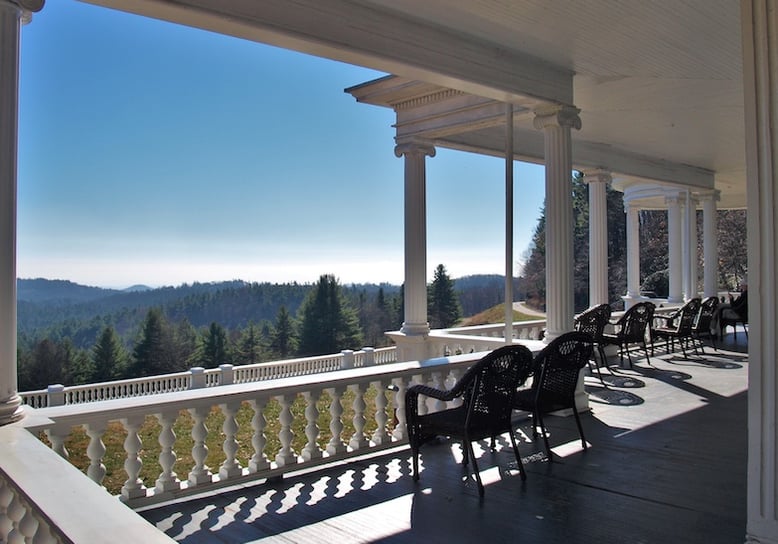
About 20 minutes south of Boone near Blowing Rock, Moses H. Cone Memorial Park preserves the former estate of a textile magnate whose fortune was built on the industrial output of post-Civil War North Carolina. The centerpiece is Flat Top Manor, built in 1901 in Beaux-Arts style. The manor house has multiple decorated rooms open to visitors, with a wide porch offering views across the grounds. The estate grounds are extensive — trails and paths run through flower-filled meadows and mixed woodlands, suitable for hiking, horseback riding, and cycling. The park sits within the Blue Ridge Parkway corridor, which gives it a protected, carefully managed quality. A craft center on the property displays and sells work by local artists year-round. The combination of architectural history, parkway scenery, and active arts programming makes Moses H. Cone Memorial Park a more layered destination than its name suggests to first-time visitors.
Grandfather Mountain Holds the Highest Point in the Blue Ridge
Half an hour southwest of Boone, Grandfather Mountain reaches 1,812 meters — the tallest peak in the entire Blue Ridge range. The state park built around the mountain is one of the most visited in North Carolina, anchored by a single attraction that earns the attention on its own: the Mile High Swinging Bridge. Strung between two of the mountain’s peaks, it is the highest suspension bridge in the United States, and the views from the span extend in every direction across successive ridgelines. Beyond the bridge, the park maintains a network of trails ranging from accessible walks to technical scrambles on exposed ridgeline. Each July, the mountain hosts the Highland Games — a gathering of Scottish clans competing in traditional events and celebrating ancestry that has been part of Appalachian culture since the earliest European settlement of the region. The combination of geology, infrastructure, and cultural programming makes Grandfather Mountain one of the more complete destinations in the High Country.
The Blue Ridge Parkway Explains the Whole Region
Understanding Boone requires understanding the Blue Ridge Parkway, because the town sits directly adjacent to one of the most significant scenic roads in the country. At 755 kilometers long, the parkway runs from Shenandoah National Park in Virginia to Great Smoky Mountains National Park in North Carolina, following the spine of the Blue Ridge range the entire distance. It passes through dense forests, open meadows, and high ridgeline with consistent views in both directions. It is the most visited unit in the entire National Park System — a fact that surprises people who assume that title belongs to Yellowstone or the Grand Canyon. From Boone, the parkway provides access to Blowing Rock, Moses H. Cone Memorial Park, and Grandfather Mountain to the south, and extends north toward Roanoke and the Virginia sections of the range. The road was designed strictly for scenic driving — no commercial vehicles, a 45 mph speed limit enforced throughout — conditions that keep it genuinely pleasant to travel across every season.