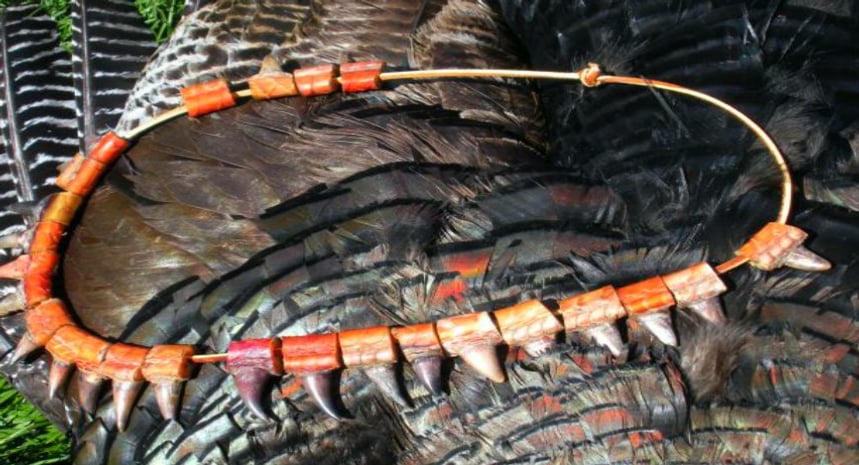
The Part of the Turkey Most Hunters Leave Behind
Every spring turkey season, hunters pack out beards and fans by the dozens. These two trophies have become the standard keepsakes of a successful hunt — framed, mounted, and hung on walls across the country. But there is a third trophy hiding on every mature gobbler that most hunters discard without a second thought: the spurs. Sharp, curved, and built over years of growth, turkey spurs are among the most striking natural structures a wild bird produces. Once you know how to remove and display them, throwing them away starts to feel like leaving a rack in the woods.
What Turkey Spurs Actually Are
Spurs are bony growths that extend from the lower leg of a male turkey, technically called a tom or gobbler. They are covered in a hard keratinous sheath — the same material that makes up fingernails and bird beaks — and they sharpen naturally as the bird moves through brush and over rough terrain. Gobblers use spurs as weapons during fights with rival males, raking and jabbing to establish dominance during breeding season. The length and curvature of a spur are direct indicators of a bird’s age. A jake, or juvenile male, will have short nubs barely worth noting. A mature two-year-old tom typically carries spurs around an inch long. A bird of three or more years can sport curved spurs exceeding an inch and a half, sometimes curving dramatically like a fishhook.
Read more
Why Spur Length Matters to Hunters
In turkey hunting circles, spur length is one of three measurements used to score a bird alongside beard length and body weight. The National Wild Turkey Federation scoring system assigns points based on these combined measurements, and spurs carry significant weight in the final tally. A gobbler with long, well-curved spurs is considered a genuinely old bird — one that has survived multiple hunting seasons, avoided predators, and outlasted competitors. That kind of longevity is worth remembering. When hunters ignore the spurs at cleaning time, they are discarding the clearest physical record of how long and hard a particular bird lived. Keeping them is not just a craft project. It is a more complete way of honoring the animal.
The Tools You Need for Removal
Removing turkey spurs does not require specialized equipment. Most hunters already have everything they need in a basic processing kit. A sharp knife is the primary tool — a fillet knife or a sturdy hunting blade both work well. Some hunters prefer a small hacksaw or bone saw for cleaner cuts, particularly when they want to preserve a longer section of leg bone above the spur. A pair of heavy gloves is worth wearing, since the spur itself is quite sharp and the leg bones can splinter during cutting. Beyond that, a flat surface and a bit of patience are all that stands between a discarded turkey leg and a finished keepsake. No boiling, no chemicals, and no advanced taxidermy knowledge required for the basic removal process.
How the Removal Process Works
The actual cutting is straightforward. Once the turkey has been harvested and the legs are accessible, locate the spur on the lower portion of the leg. The goal is to cut a section of the leg bone that includes the spur, leaving enough bone on either side to give the piece structural integrity. Most hunters cut about an inch or two of bone above the spur and a shorter section below it, creating a tube-like piece of bone with the spur extending from the side. The cut angle matters — a straight perpendicular cut produces a wider, flatter piece, while angled cuts create a narrower profile. Experimenting with cut placement on both legs of the same bird lets you match or contrast the pieces depending on what you plan to do with them.
Shaping the Piece for a Necklace
Once the spur sections are cut free, the bone tube running through the center is what makes a necklace possible. That hollow channel, when cleaned out, is wide enough to thread a leather cord or paracord through. Some hunters use a thin drill bit to open the channel slightly and ensure clean passage for the cord. Others use a coat hanger or thin wire to push through any remaining material inside the bone. The result is a natural bead with a sharp, curved spike extending from it. Strung on leather rope, a pair of turkey spurs makes a striking necklace that weighs almost nothing and requires zero synthetic materials. The leather softens over time and the spurs develop a patina, giving the piece a look that improves with age.
Cutting for Width — Getting the Right Profile
One of the most useful adjustments a hunter can make is varying where exactly they cut along the leg. The leg bone of a turkey is not uniform in diameter — it tapers as it descends toward the foot, and the bone is thicker closer to the body of the bird. Cutting higher up produces a wider, more substantial piece of bone surrounding the spur. Cutting lower gives a narrower, more delicate profile. This decision affects how the finished piece looks and how easily the cord threads through. For a necklace where both spurs need to match, taking a moment to plan the cuts on both legs before starting prevents mismatched pieces. For wall mounts or display panels, wider cuts tend to look more impressive and hold fasteners more securely.
Beyond the Necklace — Other Uses for Turkey Spurs
A necklace is the most common use, but it is far from the only option. Turkey spurs can be incorporated into panel mounts alongside the fan and beard, completing the full trophy display in a way that single-piece mounts cannot. Some hunters wire or epoxy the spur sections directly onto a piece of driftwood or cedar, creating a rustic wall piece that takes up almost no space. Others attach them to hat bands, keychain rings, or zipper pulls on hunting packs. Hanging a pair of spurs from a rearview mirror has become a recognizable tradition in turkey-hunting country — a small, durable reminder of a specific morning in the woods that does not fade or break down the way paper or fabric mementos do.
Preserving the Spurs for the Long Term
Fresh spurs pulled straight from the field will dry naturally if left in open air, but the process can take several days and the bone may crack slightly as moisture escapes. A more controlled approach is to let the cut pieces dry slowly in a cool, shaded location rather than in direct sunlight or near a heat source. Once dry, the bone can be lightly sanded if there are rough edges, then sealed with a thin coat of clear polyurethane or beeswax to prevent further cracking and to give the surface a finished appearance. The keratin sheath covering the spur itself is durable and does not need much treatment — it naturally resists moisture and holds its shape well once fully dried. Properly preserved spurs last for decades without any special storage requirements.
Matching Spurs to the Hunt They Represent
Part of what makes spur keepsakes meaningful is their specificity. Unlike a generic hunting print or a mass-produced decal, a set of spurs carries the exact age and character of one particular bird from one particular hunt. The length, curve, and coloration are unique to that gobbler. Some hunters keep a small tag or notebook entry with each set of spurs recording the date, location, and conditions of the hunt. Over several seasons, a collection of spur necklaces or mounted pairs becomes a tangible timeline of hunts — each piece distinct enough to prompt a specific memory without needing a label. That kind of specificity is rare in trophy keeping, where fans and beards from different birds can look nearly identical hanging side by side.
A Simple Addition to Any Turkey Hunter’s Routine
Removing turkey spurs adds only a few minutes to the field dressing process, and the tools required are already part of any standard hunting kit. The technique requires no prior experience with taxidermy or leatherwork — cutting, cleaning, and threading are the only skills involved. For hunters who already save beards and fans, adding spurs completes the picture of a trophy bird in a way that those two pieces alone cannot. For hunters who have never kept trophies before, spurs offer an entry point that is low-effort and low-cost. The finished piece is durable, compact, and connected directly to the hunt in a way that photographs cannot fully replicate. It is one of the simpler traditions in the field, and one of the more overlooked ones.