The Promise That Back to the Future Made
The 1989 film Back to the Future Part II showed Marty McFly gliding effortlessly above the pavement on a pink hoverboard, and for a generation of viewers it felt like a reasonable prediction — something science would deliver within a decade or two. It didn’t quite work out that way. Decades of engineering effort produced all kinds of two-wheeled scooters that marketers slapped the hoverboard label onto, but none of them actually hover. The real challenge isn’t design or manufacturing — it’s fundamental physics. Magnetic levitation, the only plausible technology for true hover, resists human control in ways that took researchers years to understand and even longer to partially solve. The gap between what movies imagined and what science could deliver turned out to be far wider than most people assumed.
The Physics Problem Nobody Talks About
The reason hoverboards are so hard to build comes down to a principle called Earnshaw’s theorem, established in 1842 by British mathematician Samuel Earnshaw. In simple terms, it states that you cannot create a stable, static equilibrium using only magnetic forces. When magnets repel each other — the basic mechanism behind any magnetic levitation device — they are inherently unstable. The repelling board wants to slide sideways, tip over, or shoot out from under a rider. Balancing that instability requires either active electronic corrections happening thousands of times per second, or a physical constraint that keeps the board in place. Most levitation demonstrations rely on supercooled materials or fixed tracks for exactly this reason. It is not a lack of funding or imagination that held back hoverboard development — it is geometry.
Read more
The Couple Who Actually Built One
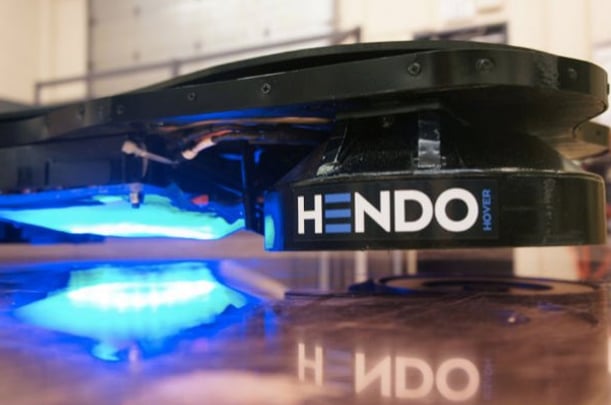
Jill and Greg Henderson, founders of a California-based technology startup called Arx Pax, became the first people to build a functional hoverboard that works through magnetic repulsion alone. Their device, called the Hendo Hoverboard, is not a concept rendering or a crowdfunded promise — it physically lifts a rider off the ground. The Hendersons came from backgrounds in construction and design rather than academic physics, and their approach to the problem was pragmatic rather than theoretical. Greg Henderson has described the hoverboard as a proof of concept, a way to demonstrate a broader magnetic technology platform in a form that is immediately understandable to anyone. The device represents years of iterative work figuring out how to make magnetic levitation controllable enough for a person to actually stand on.
How the Hendo Hoverboard Actually Levitates
The Hendo Hoverboard uses four disc-shaped motors mounted beneath the board. Each motor generates a rotating magnetic field that induces opposing magnetic currents in a conductive surface below, pushing the board upward through repulsion. Arx Pax calls this system Magnetic Field Architecture, or MFA — their specific approach to directing and shaping magnetic fields. The key difference from simple magnet-to-magnet repulsion is that MFA generates a field that only reacts to specific conductive materials, particularly copper and aluminum. That means the hoverboard does not simply float over any surface — it requires a specially prepared conducting floor to work. In the current setup, the board lifts a rider roughly one inch above the surface, which sounds modest but represents a genuine engineering achievement given how difficult controlled levitation actually is.
Why the Surface Requirement Is a Feature, Not a Flaw
The requirement for a conductive surface is the most significant practical limitation of the Hendo Hoverboard in its current form. The board cannot float over water, pavement, grass, wood floors, or most real-world surfaces. It needs a sheet of copper or aluminum to react against — which is why Arx Pax discussed building dedicated hoverboard parks at launch. This is not a design flaw so much as a physics constraint built into the MFA system. The same limitation applies to Maglev trains, which travel on specially engineered tracks and cannot run on any existing railway line. What the Hendersons demonstrated is that the levitation itself can be stable and rider-supporting — solving the surface compatibility problem is a separate engineering challenge they were already working on at the time of launch.
What Riding It Actually Feels Like
Sean Buckley, a reporter for Engadget, was among the first outside journalists to ride the Hendo Hoverboard and described the sensation in concrete terms. The board maintained a steady altitude of roughly one inch under his 200-pound frame without visible mechanical strain. There was subtle wobble — the board shifted slightly underfoot as the magnetic field responded dynamically to his weight distribution — but it did not tip, slide, or require constant physical correction to stay level. That wobble is actually meaningful: it indicates the magnetic suspension is doing active work, constantly adjusting to keep the board stable. Arx Pax confirmed that the prototype could support up to 300 pounds comfortably, with future iterations being engineered toward a 500-pound capacity. The experience is closer to standing on a raft on calm water than riding a skateboard.
The Kickstarter That Brought It Public
Arx Pax funded Hendo Hoverboard development partly through a Kickstarter campaign, using the device as a high-visibility demonstration of their underlying technology platform. Early backers who wanted an actual working hoverboard could reserve one for $10,000 — a price that reflects its status as a hand-assembled prototype rather than a consumer product. For people more interested in the engineering than the ride, Arx Pax also offered DIY developer kits for $300, containing the core magnetic drive components so hobbyists and engineers could experiment with MFA technology in their own setups. The tiered approach allowed the company to raise funds, generate awareness, and put the technology directly in front of engineers who might find novel applications for it, without positioning the hoverboard itself as a transportation product.
Buzz Aldrin Took It for a Spin
Among the early test riders who stepped onto the Hendo Hoverboard was Buzz Aldrin, the Apollo 11 astronaut who walked on the Moon in 1969. Aldrin’s appearance connected two very different chapters in the history of human transportation — a man who traveled farther from Earth than almost any other person, standing on a board floating one inch above a copper floor. It was a deliberate piece of public communication on Arx Pax’s part, a reminder that technologies which seem impractical at first can reach maturity within a human lifetime. Aldrin has spent decades advocating for ambitious engineering projects, and his willingness to ride the prototype lent a specific kind of credibility to the demonstration — not scientific validation, but a signal that the technology was real enough to stand on.
The Bigger Idea Behind the Hoverboard
The Hendo Hoverboard was never the actual goal. Greg Henderson has been explicit that the device was built to demonstrate Magnetic Field Architecture in a way that would be immediately compelling to a broad audience. The application that originally motivated development was far more ambitious: a system that could levitate structures above their foundations during natural disasters, particularly earthquakes. Henderson’s reasoning is direct — if Maglev technology can support a 50,000-kilogram train, the same physical principles should eventually be scalable to lift a building clear of seismic movement. The hoverboard is the accessible proof. A board that floats a person is easier to film, easier to fund, and easier for an investor to understand than an abstract earthquake isolation system, but both applications rely on the same core physics.
Where Magnetic Levitation Has Been Before
The Hendo Hoverboard did not arrive without precedent. Maglev trains have operated in Japan and Germany since the 1980s, using linear induction motors to achieve speeds exceeding 300 miles per hour on dedicated track systems. Magnetic levitation in laboratory settings has produced floating frogs, spinning tops, and superconducting discs held aloft above permanent magnets at cryogenic temperatures. What Arx Pax added to this history was a compact, room-temperature levitation system powerful enough to lift a person and stable enough to stand on without requiring extreme electronic feedback loops. The MFA approach differs from superconducting levitation in that it operates at normal room temperature, using rotating magnetic fields to generate repulsive force dynamically rather than relying on exotic or expensive materials that must be kept extremely cold.
Where the Technology Could Go Next
The Hendersons were already working to expand the range of surfaces MFA could work with at the time of the Hendo launch. Each improvement in surface compatibility significantly expands practical use cases. Construction and infrastructure applications are one direction — seismic isolation represents a real engineering gap, since current systems rely on mechanical springs and rubber bearings that have physical limits. Contactless transport within controlled environments like factories or warehouses represents another direction where a track-constrained magnetic platform would be entirely practical without requiring the open-surface freedom that a consumer vehicle would need. The hoverboard itself is unlikely to become a commuter product in the near term, but the technology platform it demonstrates has applications that do not require it to work on ordinary pavement.